On this page
Here's something I see every week. A business owner pours years into their brand. Thousands of followers. Customers who love them. Great food or great work. And their whole online presence is a Facebook page, an Instagram bio and maybe a DoorDash link.
Then one morning the account gets locked. Or reach drops off a cliff. Or the delivery app raises its fees. And suddenly the business can't reach its own customers.
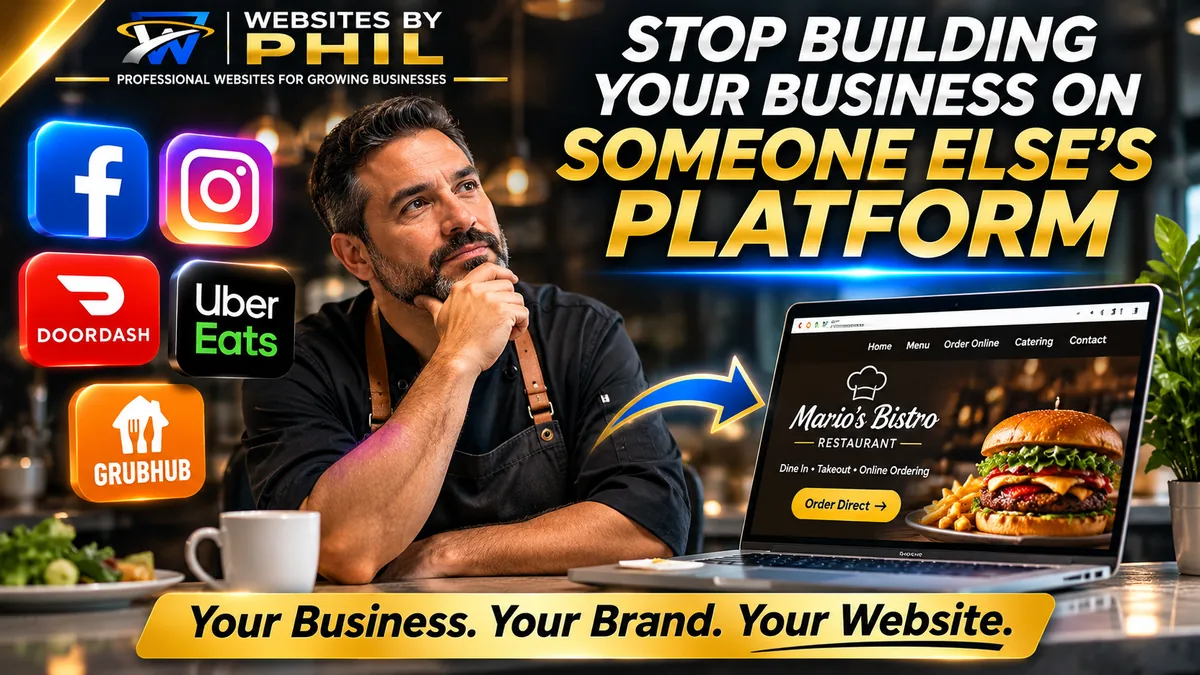
Social media and delivery apps are useful tools. They just shouldn't be the foundation of your business.
1. You're building on rented land
Your Facebook page and Instagram account live on someone else's property. You own your photos and your logo, but you don't control the platform, the algorithm, the rules or who sees your posts.
Delivery apps work the same way. They can change their fees, change how you show up in search, or restrict your account. All of it happens outside your control.
Think of social media as renting a booth at somebody else's market. Your website is your own building. You still pay for hosting and a domain, but the domain is in your name and the site is yours.
2. Followers don't always see your posts
Having 5,000 followers looks great. It doesn't mean 5,000 people see your Friday special.
The algorithm decides what shows up in people's feeds. A lot of businesses end up paying for ads just to reach people who already follow them.
A website is somewhere customers go on purpose. And it lets you build relationships you actually keep, like:
- A contact or quote form
- An email or text list for specials
- Online booking
- Direct ordering
- A loyalty program
Run those with proper consent and a privacy policy, and they're yours no matter what any app decides.
3. Delivery apps take a real cut
For restaurants, food trucks and caterers, DoorDash, Uber Eats and Grubhub bring in orders. But it costs you.
DoorDash's own merchant pricing page lists delivery commissions of 15% on its Basic plan, 25% on Plus and 30% on Premier. Other apps charge similar ranges, and marketing and promotion fees can come on top of that.
Here's a hypothetical. A restaurant does $10,000 a month through a delivery app at a 25% commission:
| Monthly | Yearly | |
|---|---|---|
| Order revenue | $10,000 | $120,000 |
| Commission (25%) | $2,500 | $30,000 |
| What's left | $7,500 | $90,000 |
That's $30,000 a year before food costs, wages and rent. Your real numbers depend on your plan and contract, but for a business on thin margins, every direct order counts.
4. Let regulars order straight from you
Your regulars already know and love your food. Why send every one of them through an app that takes a cut?
A restaurant website can give them:
- Your full menu and prices
- Online ordering for pickup or delivery
- Catering requests
- Reservations
- Gift cards and specials
- Hours, location and directions
Direct ordering isn't free. You'll still pay card processing and your ordering software, and maybe a delivery service. But it usually costs a lot less than marketplace commission. Even DoorDash's own pricing page says orders through its separate direct-ordering product are commission-free, while marketplace delivery orders carry that 15% to 30%. That gap is what being in the marketplace costs you.
The goal isn't to quit the apps. Keep them for new customers. Just stop sending your regulars through them.
5. On the apps, you're one option in a list
When someone opens a delivery app to find you, they also see every competitor near you, with discounts and free delivery right next to your name. Social media is no different: ads, suggested posts and other businesses are one scroll away.
On your own website, it's just you. You decide what's featured, what the specials are, and what button people press next.
6. Social media doesn't replace Google
When people need something, they Google it. "Soul food near me." "Catering in Orlando." "Cleaning company Ocoee."
Your Facebook page can show up, and a Google Business Profile helps a lot. But a website gives you real control over how you get found. You can have pages for each service, answer common questions, publish helpful articles, and give Google clear information about what you do and where.
A website doesn't guarantee rankings. It gives you a foundation that a Facebook page can't.
7. A website makes you look established
Picture two businesses. One has a Facebook page with old posts, mixed-up hours and no prices. The other has a clean website with the menu or services, prices, real reviews, photos of their work and an easy way to get in touch.
Which one gets your money?
That second impression is what a website buys you. It shows customers you take your business seriously.
8. What if your account gets locked?
Accounts get hacked, flagged by automated moderation, or stuck in recovery limbo all the time. Even a temporary lockout can cut you off from customers for days or weeks.
If Facebook is your only presence, customers lose your hours, your menu and your number all at once. With a website, they can still find you, order from you and contact you while you sort it out.
9. Your website keeps working when you're not posting
Social media needs constant feeding. Today's post is buried by Thursday.
A website stays put. While you're closed, it keeps:
- Taking inquiries and orders
- Showing your services or menu
- Answering common questions
- Collecting appointment requests
- Promoting your next event
- Giving out your hours and directions
10. It probably costs less than you think
The number one reason I hear for not having a website is cost. So here are my real numbers:
- Starter: $500
- Business: $1,200
- Growth: $2,000
Hosting starts at $29 a month. The Growth package includes hooking up online ordering or booking. The ordering or booking service itself is a separate bill from that company. You can see the full breakdown in my guide to what a website costs, or read what a $500 website gets you.
How much could direct ordering save?
Another hypothetical. Same restaurant, $10,000 a month through a delivery app at 25%. Say 30% of those orders move to direct ordering through the restaurant's own website.
- That's $3,000 a month in direct orders.
- At 25%, that's $750 a month in commission you don't pay, or $9,000 a year.
Subtract your card processing and ordering software, and the real savings are lower. But even after those costs, owning that slice of your orders can make a real difference to your bottom line.
Make them all work together
Facebook, Instagram and delivery apps aren't the enemy. The problem is when they're the only plan.
Use Facebook to talk with your community. Use Instagram to show off your work. Use the delivery apps to reach new customers. Use Google to get found.
Then point all of it to one place you own: your website.
I see this with Central Florida businesses constantly. Several of the sites on my examples page were built for exactly this: great local businesses whose whole online presence was a Facebook page or a delivery app. If you're in the area, here's why Orlando businesses especially need their own site.
Your business. Your brand. Your website.
Frequently asked questions
Do I need a website if I already have a Facebook page?
Yes. Keep the Facebook page, but don't let it be your only home online. A website gives you control, a place Google can send people, and a spot customers can always find your info, even if your account has problems.
Is Instagram enough for a small business?
It's great for showing off your work and staying in front of people. But it's a feed, not a home base. Your menu, prices, hours and contact info belong on a website you own.
Should restaurants stop using DoorDash and Uber Eats?
Not necessarily. They bring in new customers. The goal is to stop depending on them for everything by giving regulars a way to order straight from you.
Can my restaurant take online orders through its own website?
Yes. Your site can link to or embed an online ordering system for pickup or delivery. My Growth package includes hooking that up. The ordering service itself is billed by that company.
Can my website show up on Google without social media?
Yes. Google doesn't need your social accounts to find your site. Useful content, good setup and a Google Business Profile matter much more.
How much does a website cost?
My packages are $500, $1,200 and $2,000, with hosting from $29 a month. Your domain and files are yours.
Ready to stop renting your online presence?
Tell me what you've got going on and I'll reach out to you personally.

About Phil Byrd
Phil Byrd is the founder of Websites by Phil and The Podcast Doctor in Central Florida. He spent 20+ years in radio, broadcasting and media, including iHeartRadio and ESPN Orlando, and served as Director of Digital Marketing for a media group covering Volusia and Brevard counties before building websites for small businesses. He works with every client directly, from the first conversation to launch and beyond.
More about Phil